:: Wednesday, November 22, 2006


  ZoneAlarm Suite Integrates Kaspersky Antivirus

Zone Labs, a division of Check Point Software Technologies, is planning to release tomorrow a public beta for ZoneAlarm Internet Security Suite 7.0. This is the upgrade to the 6.0 product, which ranked sixth in our All-in-One Security suite round-up earlier this year.

While we haven’t looked at it yet, version 7.0 looks promising since Zone Labs is integrating the top-performing Kaspersky antivirus engine. (To get an idea of how it performs, read our review of Kaspersky Internet Security 6.0.) The Kasperksy engine replaces a lackluster version of the CA antivirus engine that was integrated into ZoneAlarm 6.0.

Two antispyware companies are also working in antivirus protection. PC Tools plans to offer antivirus protection as an option for the upcoming 5.0 version of Spyware Doctor. Webroot is partnering with Sophos, a well-known enterprise-level security company, to provide antivirus protection with Spy Sweeper. Depending on how nicely they play together, this coupling of targeted antivirus and antispyware components might be a better solution for people who find the large security suites too boated.
:: full article

:: Tuesday, November 21, 2006


  Citibank Debuts Biometric Pay System

Citibank Singapore is offering a new way for credit-card holders to make payments -- using their fingerprints instead of credit cards.

Citibank this month began rolling out biometric payment systems in Singapore that allow Citibank Clear Platinum credit card holders to pay using their fingerprints. "It's an investment for our future," said Anand Cavale, vice president and business director of credit payment products at Citibank Singapore, noting this is the first time the bank has used a biometric payment system anywhere in the world.

Before putting the biometric system into operation, Citibank officials took a long hard look at whether the system was secure -- and came away satisfied that it was, Cavale said. "We see this as the next step, which will enhance our already good fraud prevention systems," he said.


With an affluent, tech-savvy population of 4.5 million, Singapore is among the most competitive for credit-card issuers, with many Singaporeans carrying three or four cards in their wallets. To encourage card holders to spend, banks regularly team up with partners to offer special discounts -- say, 10 percent off dinner at a trendy restaurant -- if customers use a certain credit card.

So much competition leaves banks looking for any edge they can find.

For its part, Citibank hopes the biometric technology makes payment more convenient for its card holders, eliminating the need for them to always carry credit cards while still allowing them to buy things. But don't expect to see biometrics replace Citibank cards any time soon. "The technology will be used in conjunction with a credit card," Cavale said.

Cavale believes biometric payments systems will shine in applications where a quick payment method is needed. "If you're running to catch a train, and buying a cup of coffee and a newspaper, your time has more value," he said.

So far, Citibank's biometric payment systems are only in place at a handful of outlets in Singapore, including local coffee shops and the popular Zouk night club. But the bank has plans to quickly expand the number of such systems and the number of Citibank card holders able to use them.

"Our intention is to roll it out very quickly to other cards," Cavale said.

Citibank chose to start the rollout of the biometric payment system with the Clear Platinum card because it is targeted at younger Singaporeans, ranging in age from 25 to 34. "We launched with this segment because the uptake is going to be very strong," he said.

Getting signed up to use the biometric payment system, provided by Pay By Touch, of San Francisco, is relatively easy. Citibank has installed kiosks at several Singapore branches where card holders can register their fingerprints. To sign up, Citibank customers need to provide valid photo identification and a seven-digit numeric passcode used with the fingerprint to authenticate payment.

This is the first time that Citibank has tested a biometric payment system, and the bank's operations in other countries, especially in Asia, are watching what happens in Singapore with interest, Cavale said. "Our plans include taking this technology around the region," he said.

:: full article

:: Monday, November 20, 2006


  Toshiba Readies 8GB SD Card

Toshiba plans to release in January an 8GB high-speed Secure Digital (SD) memory card, according to Martyn Williams, IDG News Service colleague reporting from Tokyo.

The card will support the "class 4" high-speed data writing specification of the SD Card Association and be able to record data at 6 megabits per second, say Toshiba representatives. That kind of speed plus the high capacity of the card makes it well suited to applications such as video recording using devices such as Panasonic's recently announced HDC-SD1 camcorder.


That camera records high-definition video to an SD card at 6Mbps. Toshiba's new card should be able to hold about three hours worth of such video.

The card will cost about $340 in Japan. Toshiba plans to begin selling it in early January there, in North America, and in Europe.

:: full article

  AMD Layoffs Announced

Four weeks after beating Wall Street estimates for financial earnings, chip maker Advanced Micro Devices will lay off 375 workers, according to published reports.

The move will weed out redundant positions caused by AMD's acquisition of graphics chip maker ATI Technologies on October 25, analysts said. It could also give AMD extra resources in its competition with rival Intel. The layoffs were reported in various newspapers with information attributed to an AMD spokesman. AMD did not return calls seeking confirmation.


AMD has been winning spots for its chips on computers from vendors such as Dell and IBM in recent months, despite a raft of new processors launched by Intel. To keep that momentum rolling, AMD must increase its production capacity, said Martin Kariithi, an analyst with Technology Business Research.

The company can gain the flexibility to do that by cutting redundant jobs in the sales and marketing and general and administrative departments (SG&A), he said.

AMD has announced plans to combine its processors with ATI's graphics and chip set technologies to create a family of more integrated chips for PCs and other consumer electronics devices. Once it has launched those new chips, AMD might replace some of the lost positions.

"From a manufacturing standpoint, AMD will keep driving to increase production capacity to keep gunning for Intel," Kariithi said. "To facilitate this I expect AMD to continue increasing its manufacturing, tech support, and engineering workforce. Toward mid-2007 AMD will once again seek to boost SG&A staff in order support the new ATI/AMD products coming to market at that time."

The number of layoffs is small, both in comparison to AMD's total roster of nearly 15,000 employees and to Intel's plan to cut 10,500 jobs by the middle of 2007, amounting to about 10 percent of its workforce.

Still, AMD has been so successful lately that the cuts came as a surprise. AMD reported third-quarter profits of $134 million in October, more than three times its number for that period last year.
:: full article

:: Sunday, November 19, 2006


  Free AOL Stuff, Courtesy Of Bubble 2.0

Yes, it's 1999 all over again. Web start-ups are cropping up with names like Bebo, Squidoo and Moblabber. Start-ups like YouTube, less than a year old and unprofitable, are being sold for $1.65 billion. And the business plan known as Free has returned. You know, "We lose money on every transaction, but we'll make it up in volume."

One of the most surprising participants in Web Bubble 2.0 is AOL, the company formerly known as America Online. On August 2, it announced what might seem to be the craziest business plan yet: a 100 percent price reduction. The monthly membership fee dropped from $26 a month to...nothing.

Was AOL nuts? Should its executives be dragged away by the nice men in white coats?

It turns out that only AOL's features, sites and services are free, not the Internet connections that were once its bread and butter. AOL had been losing members at a staggering rate, with 300,000 people a month canceling their AOL accounts as they switched to high-speed Internet from their cable and phone companies. AOL now has fewer than 18 million members, down from 35 million in 2002.

So AOL decided to get out of the Internet service-provider game, a dead-end business for a company that doesn't actually own the wires running to your home.

How, then, does AOL expect to make money--especially considering its promise not to increase the already copious number of ads on its pages?

First, abandoning its efforts to sign up subscribers will save hundreds of millions of dollars a year right off the bat. You read that right: AOL has stopped carpet-bombing the nation's mailboxes with AOL starter discs. No more "Sign up now!" TV ads, either.

And then there are those ads on AOL itself. Since it went free, AOL has lost 2.5 million paying subscribers--but gained 3 million free members. That's more people looking at the ads, which AOL figures will attract even more advertisers.

All right, so much for AOL's interests. What's in it for you?

Truth is, AOL looks a lot like Yahoo these days: It's a portal to e-mail, chat rooms, news, classifieds, personal ads and discussion areas. There's a Flickr-type thing (post photos for friends to see--and order prints), a Google Video-type thing (post homemade videos or buy network TV episodes), a Weather.com-type thing, and so on. There's also a Google-esque search service that's powered by Google itself.

Most of AOL's goodies are available from any Web browser. In other words, you don't need to sign up for anything, and you don't need the old AOL client software--you know, the all-inclusive Internet dashboard that greets you with "Welcome! You've got mail!"

But even in its free version, AOL is not for everyone. AOL's "sanitized for your protection" approach still doesn't appeal to the technically proficient. One member of Digg.com, the techie news service, complaining about AOL's "ad-infested" pages, suggested that AOL "should reverse their model entirely, and pay us to browse."

Take this simple test: Do you know how to find your IP address, subscribe to RSS feeds or know what "FWIW" stands for? If so, you'll probably find AOL too mass-market for your tastes.

Still, a few AOL goodies, once reserved for paying members, are especially attractive now. For example:

Parental controls
AOL remains one of the most effective front doors to the Internet for households with children. You can specify which Web pages and chat or e-mail partners are off-limits, or let AOL do the blocking for you. You can limit your child's time online, by quantity or times of day. AOL can send you daily activity reports about your offspring by e-mail. AOL even adjusts the screen design and features according to your child's age.

A free add-on program for Windows called Internet Access Controls even stops enterprising young hackers from bypassing the parental controls by using other browsers and chat programs.

XM radio
AOL offers a couple of hundred free Internet radio stations (aolradio.com)--nothing exclusive there. But 20 of them are commercial-free music channels from XM Satellite Radio. The audio and programming quality are very high; the 20 free channels include some of XM's best.

OpenRide
If you have broadband, you're encouraged to download a new AOL dashboard called OpenRide (Windows XP only) instead of the aging Mac or Windows client software. Unlike the old software, which cluttered your screen with windows, OpenRide offers all of AOL in a single window.

It's divided into quadrants, dedicated to the Web, chat, video and audio, and e-mail (for both AOL mail and your other e-mail accounts). You can drag the intersection of the panes to resize all four panes at once, or click inside a pane to make it fill most of your window. The other three shrink down to little tabs.

The geek intelligentsia spit upon OpenRide, too, partly because of the banner ad across the window and partly because its individual components aren't as complete as standalone programs. For example, OpenRide doesn't offer RSS news feeds (self-updating lists of headlines from news sites and blogs of your choosing).

But the truth is, the four-pane approach really works. That, and OpenRide's tabbed browser design, keep novices from getting lost on the Internet.

Online backup
All free AOL account holders get 5GB of free online storage for backing up data, transferring big files to other people, and so on. Windows users even get a free backup program that automatically copies selected folders to this virtual hard drive (called Xdrive) on a schedule. The software is clean, easy to use and extremely convenient.

Antivirus software
AOL's free security suite for Windows offers both real-time virus protection and virus scanning (it's based on McAfee's software). The suite also includes protection against spyware, pop-up windows, phishing scams and spam. Commercial security suites cost $50 or $70 a year. So if you don't mind seeing a banner ad even in your virus software, this is quite a deal.

A custom e-mail address
AOL lets you choose an address ending in @aol.com or anything else you want, as long as it's available--so you can be david@thepogues.com or david@poguefamily.com. Then you can set up other addresses with the same suffix for friends or family. (To enforce its "one custom address per person" policy, AOL requires that you sign up using a cell phone number. It insists that it does nothing else with this information.)

There aren't many advantages to signing up for a free AOL account (as opposed to just using its features anonymously), but the AOL or custom e-mail address is one of them. The others include unlimited online photo storage and the option to use the AOL client software or OpenRide.

AOL still sells subscriptions, by the way, for $10 or $26 a month. Such memberships grant you dial-up access, 50 more XM radio stations, unlimited e-mail storage (versus 2GB for freeloaders), a 50GB Xdrive, identity-theft and PC-malfunction insurance, and so on.

But even the free AOL has a lot to offer. If you're a parent or a technophobe, AOL is still one of the easiest, safest Internet on-ramps. And even if you're an experienced Netizen, you should help yourself to the free antivirus software, or at least a custom e-mail address and a few satellite radio channels to listen to as you work. AOL's video search, meanwhile, is one of the Web's best; it finds video clips from all over the Web, including YouTube.

If you're already an AOL member, you can switch to a free or less expensive plan at AOL keyword "Change Plan." You don't have to give up your AOL e-mail address; in fact, if you quit AOL within the last two years, you can still get your old address back.

But if you plan to switch, do it soon. If the last tech bubble taught us anything, it's that freebies like these don't last forever.
:: full article

  *Fact Of The Week* - How Good Is A Banana?

Did you ever wonder what different types of effect certain fruits had on your body? I did a little research on Bananas and found some pretty interesting facts. Some of these facts could possibly help you live a healthier and longer life.

Anaemia: High in iron, bananas can stimulate the production of haemoglobin in the blood and so helps in cases of anaemia.

Blood Pressure: This unique tropical fruit is extremely high in potassium yet low in salt, making it the perfect food for helping to beat blood pressure. So much so, the US Food and Drug Administration has just allowed the banana industry to make official claims for the fruit’s ability to reduce the risk of blood pressure and stroke.

Brain Power: 200 students at an English school were helped through their exams by eating bananas at breakfast, break and lunch in a bid to boost their brain power. Research has shown that the potassium-packed fruit can assist learning by making pupils more alert.

Constipation: High in fibre, including bananas in the diet can help restore normal bowel action, helping to overcome the problem without resorting to laxatives.

Depression: According to a recent survey undertaken by MIND amongst people suffering from depression, many felt much better after eating a banana. This is because bananas contain tryptophan, a type of protein that the body converts into serotonin – known to make you relax, improve your mood and generally make you feel happier.

Hangovers: One of the quickest ways of curing a hangover is to make a banana milkshake, sweetened with honey. The banana calms the stomach and, with the help of the honey, builds up depleted blood sugar levels, while the milk soothes and re-hydrates your system.

Heartburn: Bananas have a natural antacid effect in the body so if you suffer from heart-burn, try eating a banana for soothing relief.

Morning Sickness: Snacking on bananas between meals helps to keep blood sugar levels up and avoid morning sickness.

Mosquito bites: Before reaching for the insect bite cream, try rubbing the affected area with the inside of a banana skin. Many people find it amazingly successful at reducing swelling and irritation.

Nerves: Bananas are high in B vitamins that help calm the nervous system.

Overweight and at work: Studies at the Institute of Psychology in Austria found pressure at work leads to gorging on comfort food like chocolate and crisps. Looking at 5,000 hospital patients, researchers found the most obese were more likely to be in high-pressure jobs. The report concluded that, to avoid panic-induced food cravings, we need to control our blood sugar levels by snacking on high carbohydrate foods – such as bananas – every two hours to keep levels steady.

PMS: Forget the pills – eat a banana. The vitamin B6 it contains regulates blood glucose levels, which can affect your mood.

Seasonal Affective Disorder (SAD): Bananas can help SAD sufferers because they contain the natural mood enhancer, trypotophan.

Smoking: Bananas can also help people trying to give up smoking, as the high levels of Vitamin C, A1, B6, B12 they contain, as well as the potassium and magnesium found in them, help the body recover from the effects of nicotine withdrawal.

Stress: Potassium is a vital mineral, which helps normalise the heartbeat, sends oxygen to the brain and regulates your body’s water-balance. When we are stressed, our metabolic rate rises, thereby reducing our potassium levels. These can be re-balanced with the help of a high-potassium banana snack.

Strokes: According to research in ‘The New England Journal of Medicine’ eating bananas as part of a regular diet can cut the risk of death by strokes by as much as 40%!

Temperature control: Many other cultures see bananas as a ‘cooling’ fruit that can lower both the physical and emotional temperature of expectant mothers. In Thailand, for example, pregnant women eat bananas to ensure their baby is born with a cool temperature.

Ulcers: The banana is used as the dietary food against intestinal disorders because of its soft texture and smoothness. It is the only raw fruit that can be eaten without distress in over-chronic ulcer cases. It also neutralises over-acidity and reduces irritation by coating the lining of the stomach.

Warts: Those keen on natural alternatives swear that, if you want to kill off a wart, take a piece of banana skin and place it on the wart, with the yellow side out. Carefully hold the skin in place with a plaster or surgical tape!


:: full article

  New Google Service Will Manipulate Caller-ID

Google has made available a new "Click-to-Call" service that will automatically connect users to business phone listings found via Google search results.

In order for this feature to function, the user must provide their telephone number so that Google can bridge the free call between the business and the user (including long distance calls).


An obvious issue with such a service is that there is no reasonable way to validate the user phone number that is provided. Google says that they have mechanisms in place to try avoid repeated prank calls, but the potential for abuse is obvious.

Of even greater concern is that Google says that it will manipulate the caller-ID on the calls made to the user-provided number, to match that of the business being called. This is extremely problematic, since it could be used to try to convince a prank target that they were being called directly by the business in question, and so cause that target to direct their anger at the innocent business. In the case of targets who are on do-not-call lists, it is possible to imagine legal action being taken by callers upset that the business in question called them "illegally," though in fact the call had been made by the Google system.

Google's explanation for this caller-ID manipulation is that it would be handy to have the called business number in your caller-ID for future calls. That may be true, but the abuse potential is way too high. Caller-ID should never be falsified.

I've written many times about how caller-ID can be manipulated to display false or misleading information, why this should be prevented, and how the telcos have shown little interest in fixing caller-ID or informing their customers about the problem (caller-ID is a cash cow for the telcos whether it is accurate or not).

Up to now, the typical available avenue for manipulating caller-ID has been pay services that tended to limit the potential for largescale abuse since users are charged for access. Google, by providing a free service that will place calls and manipulate caller-ID, vastly increases the scope of the problem. Scale matters.

Google has not vetted this caller-ID feature sufficiently, and I urge its immediate reconsideration.
:: full article

:: Saturday, November 18, 2006


  Grand Theft Mario Bros


  10 Tips On Buying A HDTV

Making the leap to HDTV is a no brainer: Go to the superstore, settle on a size, pick a model with the best picture for the price, and pay the cashier. Piece of cake, right? Wrong. For lots of reasons. Like how do you know if you’re getting the highest definition picture possible. Or whether that hi-def DVD player you’re thinking of buying as well will connect properly to your new HDTV. Knowing the essential ins and outs of HDTV before you leave the house means you won’t be sorry after you bring home your big new purchase. Here are the top 10 things to know before you buy:


1. Genuine HDTV? A minimum of 1280 x 720 pixels — or little points of light — means you’re in genuine HDTV waters, while EDTVs (enhanced definition TV), offer lower resolutions. Make sure you go with true HDTV. And absolutely make sure the set has at least one HDMI connection port that supports 1080p and supports HDCP, the connection and protocol that guarantees you’ll be able to plug in a Blue-Ray or HD-DVD DVD player, as well as receive and view copy protected broadcasts.

2. Slim is in. The popular plasma type HDTVs tout generally “truer blacks” when it comes to contrast, while LCD, which costs more per inch, is typically brighter. Huge, boxy rear projection sets are cheap, but the viewing angle and brightness can be spotty. Consider an HDTV projector if you want to fill a whole wall. Lastly, experts agree that “tube” type HDTVs have the best picture, and apart from the fact they’re a dying breed, you’ll need to recruit half a football team to haul one into the house.

3. My favorite movie. Test drive potential HDTV purchases with your own DVD. Colorful, fast-moving titles like Pirates of the Caribbean work best. Pay special attention to the set's ability to handle quick action without the picture breaking up. A faster “response rate” means no blocky pixels when watching the Super Bowl. And be ready for a little shocker: Channels that are not broadcast in HD won’t look very pretty and some will look downright ugly, because the poor quality of standard broadcast gets magnified – and uglified – by your new, super-sharp screen.

4. How hi is up? Cable channels that offer HD generally broadcast in 720p, which is great quality, while some transmit in 1080i, which is even higher, though many debate on whether it’s actually better. Most HDTVs offer some or all of three resolutions: 480p, 720p, 1080i. Some of the latest HDTVs are beginning to offer 1080p, but they cost more. Get at least 720p and 1080i capability in your choice.

5. Tune in or out? To grab free, local high-def network channels over the air with an antenna, make sure your HDTV has a built-in tuner. For beyond-basic cable or satellite subscribers, consider an HDTV-capable “display,” or “monitor,” which leaves out the built-in tuner to save some bucks.

6. Good connections. While most HDTVs have component (red, green and blue) video inputs to connect to your cable, satellite tuner and DVD player, double check to make sure. Two or more sets means no swapping cables between cable and DVD and Xbox 360, for instance. Also, I repeat — make sure your new HDTV has an HDMI input with HDCP support — the connection and anti-piracy combo that future-proofs your purchase for years to come.

7. Plugging in. Connect your gear together using the highest resolution connections possible. DVI/HDMI is highest, followed by component, S-Video, plain Video-in, and finally the lowliest of low-quality lows, old fashioned Coax. HDTV cable and video games require at least the component connection, while hi-def Blu-Ray and HD-DVD players will plug in to the HDMI port for the highest resolution possible.

8. Wide or Not. You can choose between showing bars on either side of a non-widescreen program so that the image looks correct, or you can zoom it to fill the screen. But doing so will squash and widen people and objects. Experiment with the TV’s remote, and your cable or satellite box’s remote, to attain the best look.

9. Make Adjustments. HDTVs ship from the factory with the settings cranked up high in order to show off on the showroom floor. At home, kick things down a few notches by choosing the built-in picture preset settings like “Sports,” or “Vivid,” or “Natural.” Tune to a program with dark and light scenery (or use a DVD), to help find the picture-perfect balance.

10. Surrounded by Sound. Now that you’re feasting your eyes on a super hi-def picture, don’t forget the sound. HDTV boasts Cineplex-like surround sound – providing you have a receiver and speaker system to hear it. Those “Home Theater in a Box” systems have DVD players built-in, or consider a separate receiver and speaker system if you plan to buy a Blu-Ray or HD-DVD player. And make sure to use the “optical” or “digital audio” sound outputs from your HDTV cable or satellite or video game box when you connect to the receiver – that way you’re sure to be surround by the best possible sound around.
:: full article

  KFC, Giant Colonel Sanders Visible From Space

Kentucky Fried Chicken reckons it's the first company whose logo is visible from space after piecing together a huge mosaic of Colonel Sanders in the Nevada desert.

The pic of the Colonel comprises 65,000 one-foot-square painted tiles laid out on a plot near Rachel, Nevada. Gone is Sanders' traditional suit, replaced by a with-it and happening red apron.


Black helicopter aficionados among you will know that Rachel lies east of Area 51, and KFC big cheese Gregg Dedrick duly said in a statement: "If there are extraterrestrials in outer space, KFC wants to become their restaurant of choice." He added: "If we hear back from a life form in space today - whether NASA astronauts or a signal from some life form on Mars - we'll send up some Original Recipe Chicken."
:: full article

:: Friday, November 17, 2006


  Sony Explains PS3, Blu-ray & HDTV

Read Sony’s explanation of PS3, Blu-ray and HDTV. Compatibility, formats, and what you need for Playstation 3 High Definition gaming.According to Sony, a new world of incredibly detailed games and movies awaits us - but to enjoy it to its full potential, you’re going to want to view your entertainment from High Definition media on a High Definition screen. These two aspects of PLAYSTATION3 entertainment are contained within Blu-ray discs and High Definition TV.

What is Blu-ray?

Blu-ray Disc (BD) is a next generation optical disc format meant for containing high-definition video and games.

The name Blu-ray is derived from the blue-violet laser it uses to read and write to the disc.

Why is there new media?

While a standard DVD disc can only contain one movie and limited bonus features, a single Blu-ray Disc (BRD) can hold the equivalent of 10 DVD movies and extras or 10 PlayStation 2 games on one disc.

This huge amount of space is important, because High-Definition, next generation graphics will take up much more data than found in existing games and movies.

What are the main benefits of Blu-ray?

With Blu-ray, game developers are free to get on with creating amazing imagery and game engines, without having to cut corners to fit it all onto a DVD. Similarly, High Definition movies can be fitted onto a BRD with ease.

Simply, if you’re going to have full-length HD movies and games with incredible, high resolution graphics, you need a next generation storage medium to match. That’s Blu-ray.
Can I still play my PlayStation 2 games and DVD movie collection on PLAYSTATION 3?

The PLAYSTATION 3 has backward compatibility for all PSOne and PlayStation 2 games. It will also play DVDs, CDs and SACDs.
So how do I view High Definition movies and next generation graphics?

PLAYSTATION 3 will be a HD player and use next generation graphics. To get all the benefits of High Definition movies and next generation graphics you will require a HDTV to view them on.

What is HDTV?

Well, with ‘HD ready’ televisions, pictures are displayed at a much higher resolution than with standard TV - resulting in more visual information and a much more detailed, realistic scene.

And it’s not just PLAYSTATION 3 games that are set to benefit from the move to HD. Television will soon be broadcast in HD (Sky’s HD service launches in 2006 in the UK, for example, and other services will follow), and HD movies will be available on Blu-ray.

PLAYSTATION 3 will fully support the full range of High Definition resolutions (as well as standard TV resolution), so games and movies can be displayed to their full potential.

How does High Definition work?

A High Definition picture is clearer and sharper than current television because it contains more information in digital form. High Definition television is about four or five times sharper than a Standard Definition picture.

The three resolutions that constitute HD are called 720p, 1080i, and 1080p. (PLAYSTATION 3 is the only console that will support 1080p, True HD resolution). The number refers to the amount of horizontal lines the screen displays, while the ‘i’ or ‘p’ refers to ‘interlaced’ and ‘progressive’.
What is ‘interlaced’ and ‘progressive’?

There are two types of TV projection, ‘interlaced’ and ‘progressive’. With, interlaced images, the screen displays alternate lines so that only half the screen is displayed any one time. The TV switches which lines are displayed every frame, or refresh, so fast that you see the whole image.

With progressive scan images, all the lines on the screen are displayed with each and every refresh. This makes for a spectacular, beautifully clear image, and explains why 1080p is so desirable - it has the most lines (and therefore the most detail), all displayed at once.

The three resolutions that constitute HD are called 720p, 1080i, and 1080p (PLAYSTATION 3 is the only console that will support 1080p, the ultimate HD resolution).

Do I have to upgrade my TV?

Just as the transition from black and white to colour in the 1960’s, PLAYSTATION 3 will unleash a new world of entertainment. A number of HDTV sets will allow you to take full advantage of this new technology. But don’t despair, even with a standard TV, PLAYSTATION 3 will look great.

So how do I know what to look for and where can I get one?

There’s no shortage of sets capable of displaying High Definition. Look out for an ‘HD ready’ sticker when you are looking at TVs - to be officially ‘HD ready’, a set must be able to support both 720p and 1080i at 50Hz and 60Hz (or frames per second).

HD ready sets such as those in the new Sony BRAVIA range are becoming increasingly affordable, and when they’re supplied with HD games and movies, you won’t be able to believe your eyes.

How much will PLAYSTATION 3 cost?

Equipped with a Blu-ray drive, pre-installed hard disk drive (HDD) and Wireless controller as standard, PLAYSTATION 3 will be available at in Europe at €499 (20GB) and €599 (60GB).

What is the difference between the two models?

Although there are two configurations for PLAYSTATION 3, the key elements are standard – Blu-ray disc, Cell chip, Giga-bit Ethernet to provide an always-on connection to the network, and a pre-installed hard disk drive (HDD) as standard.

On top of these great features, the 60GB HDD version includes support for compact flash, SD and Memory Stick Duo, Wireless connectivity and an HDMI connection for output on HDTV.

When will PLAYSTATION 3 be launched?

PLAYSTATION 3 will launch on November 17, 2006 .

:: full article

  Intel Clubs AMD With Quad Cores

Intel has earned the right to lay it on four-cores thick. The chipmaker today officially released versions of its four-core server and PC chips. The appearance of the 'Clovertown' and 'Kentsfield' processors gives Intel both a marketing and raw performance edge over AMD, which doesn't plan to fire up its own four-core gear in earnest until 2007. So, those looking for the best of the best will turn to Intel for the time being.

Those of you aiming to purchase Intel's latest kit will want to look for the Xeon Processor 5300 Series chips on the server, and the Core 2 Extreme QX6700 on the desktop - see our review of the chip. Both the server and PC chips can plug into existing dual-core Intel-based systems.
All in all, there isn't much magic to Intel's final quad-core reveal. The company has been promising to deliver the new chips for months, hoping to end a three-year slump against AMD. And by most accounts Intel has succeeded in this goal.

Initially, Intel will ship four versions of the Xeon 5300 Series chips. Three of these chips will consume 80W, while a higher-powered version will chew through 120W. In the first quarter of next year, Intel plans to release a 50W part as well.

Reporters were shown an impressive list of benchmarks where the 80W Xeons creamed AMD's latest and greatest Opteron chips. As expected, multi-threaded applications showed the most dramatic speed up, running between 2x and 4x faster on Intel's new gear.

"I think it is fair to say we deliver unquestioned leadership in the server market at this point," said Intel VP Steve Smith in an interview with El Reg.

To help entice customers that defected to AMD to return to the fold, Intel is charging the same price for the mainstream four-core chips that it charged for dual-core chips.

The benefits of a four-core chip in the desktop market are less obvious given a relative lack of multi-threaded software.

That said, customers can expect to see major speeds up with 64-bit OSes, media software and gaming applications. In addition, engineers looking for the speediest workstations will likely lean toward Intel's new kit.

"I would not be surprised if we ship more than 1 million units before the competition ships its first quad-core chip," Smith said.

The high-end Xeon X5355 running at 2.66GHz with a 1,333MHz front side bus starts at $1,172 in volume purchases. The 2.33GHz E5345 with a 1333MHz front side bus costs $851, the 1.86GHz E5320 with a 1,066MHz front side bus costs $690, and the 1.60GHz E5310 with a 1,066MHz front side bus costs $455.

The desktop chip running at 2.66GHz with a 1,066MHz front side bus costs $999.

:: full article

:: Thursday, November 16, 2006


  NetZero Goes Broadband

Dial-up Internet service provider United Online said Thursday it is entering the broadband market.

The company, which sells dial-up service under the NetZero and Juno brands, will offer a new service, called NetZero Digital Subscriber Line (DSL), using infrastructure leased from Verizon Communications. The service will be sold within Verizon's DSL service area.

United Online's broadband play is yet another sign that the Internet dial-up business is dying on the vine. For the past several quarters service providers such as EarthLink and AOL have reported steep declines in subscribers as people ditch dial-up for faster, broadband services. United Online reported that revenue from its Internet access business for the third quarter declined 15 percent compared to the same quarter in 2005.

Meanwhile EarthLink saw its dial-up subscriptions decline by 81,000 dial-up subscribers during the third quarter. But it gained 47,000 new subscribers for its broadband business, boosting broadband revenue 37 percent to $149.4 million.

Competing directly with the phone companies and cable operators for broadband customers won't be easy, however, because these service providers own the infrastructure that United Online and others, such as EarthLink, lease to deliver similar services. The situation could get even more difficult as the Federal Communications Commission fazes out regulations that have kept in check wholesale prices for network access.

Because Verizon will be able to charge whatever it wants for wholesale access to its infrastructure, it will be difficult for United Online to offer a cheaper service than Verizon. In fact, pricing for the new NetZero services is actually more expensive than that currently charged by Verizon. For example, NetZero is offering a 768 kilobits-per-second download service for an introductory price of $14.95 for the first six months. After that, the price jumps to $19.95 per month. Verizon also offers this service for $14.95, but the price does not increase.

NetZero is also offering a 1.5 megabit-per-second service for $19.95 per month for the first six months. The service will cost $29.95 per month after the introductory period ends. Verizon offers a 3Mbps service for $29.95.

Both NetZero products require a six-month commitment from customers. The service can be ordered on the company's Web site.

:: full article

  Google Free Cell Phone Service?

(Reuters) SAN FRANCISCO - Web search leader Google Inc.'s chief executive, Eric Schmidt, sees a future where mobile phones are free to consumers who accept watching targeted forms of advertising.

Schmidt said Saturday that as mobile phones become more like handheld computers and consumers spend as much as eight to 10 hours a day talking, texting and using the Web on these devices, advertising becomes a viable form of subsidy.

"Your mobile phone should be free," Schmidt told Reuters. "It just makes sense that subsidies should increase" as advertising rises on mobile phones.

He was interviewed following a speech on the theme of business innovation organized by Italian student groups and the Graduate School of Business at Stanford University.

Schmidt also said his company was working on how to allow users to maintain basic control of their personal data.

Currently, Google stores consumer data on hundreds of thousands of its own computers in order to provide additional services to individual users. The company is looking to allow consumers to export their Web search history or e-mail archives and move them to other sites, if they so choose.

"We are working to ensure that as long as it is yours, we want to give you the equivalent of number portability," Schmidt said at another conference earlier this week. Portability is a government-mandated program that allows consumers to retain their mobile phone numbers when they switch carriers.

This undertaking is both a recognition of users' right to control their personal information, an effort to head off regulatory action and a response to an increasing trend on the Internet toward openness rather than exclusivity, he said.

"Data should never be held hostage. We might as well get ahead of it before a law gets passed forcing us to do that."

Google is experimenting with delivering text, brand-image and video ads onto small-screen mobile phones. It is enjoying early success in its strategy to win phone network allies in Japan, where TV viewing and shopping on phones is advanced, he said.

The Google executive said his own company had no plans to directly give away phones itself, nor is he aware of any effort by partners such as phone makers Nokia or Motorola or mobile operators like Vodafone to make such a radical move, he said.

Schmidt acknowledged that mobile phones may never become totally free to the consumer. Newspapers are still not completely free a hundred years after they started relying on advertising, but they certainly are inexpensive, he noted.

The company, which will derive virtually all of its expected $10 billion in revenue this year from selling text ads to computer users who use Google to search the Web, has said previously it expected mobile phone advertising to match computer-based ad revenue over time.

:: full article

:: Wednesday, November 15, 2006


  Zune and Vista 'not compatible'

Zune, the new digital music player from Microsoft, is not compatible with the software giant's new Vista operating system.

Buried in the Zune website, Microsoft admits that the player is not compatible with Vista and gives no information as to when it will introduce a patch or update enabling the player to do so.

Instead, users are asked to "check back soon for updates".

Microsoft is set to launch Vista for business customers later this month, although a spokesman for Microsoft told ENN, however, that a new "Zune client" or patch to make Vista compatible with the MP3 player will be released at the end of January to coincide with the consumer launch of the Vista operating system.

This is embarrassing for Microsoft given it launched the new player in the US amid much fanfare on Wednesday in an attempt to take on the might of Apple's iPod. At the same time, Microsoft is touting its much-delayed new Vista version of Windows as "the most important new Microsoft release since Windows 95", according to company founder Bill Gates.

Zune is currently only available in the US and went on sale for USD249.99 at almost 30,000 shops across the United States on Wednesday. The digital music player comes in just one 30GB model and is available in three colours: black, white and brown.

A European launch is expected some time next year

Zune is designed to be used with its co-branded online music store Marketplace, where songs can be purchased for download.

The big difference between the Zune player and the iPod is that the Zune is wireless. The player comes with a wi-fi connection which will allow users to share music with other Zune users. Tracks may be shared with up to three other Zune owners, although shared songs will delete themselves after three days. Unlike the iPod, the Zune also includes an FM radio.

Microsoft hopes these features will help it corner some of the digital music player market dominated by rival Apple.

However, in what is sure to be an unpopular move, songs bought from Microsoft's own MSN music store - which is being closed down - will not work on a Zune player.

Instead Zune users must buy and download music from the dedicated Zune music store, or rip their own CDs and copy them onto the player.

:: full article

  Alienware Area-51 ALX


Fans of high-end boutique PCs were shocked when the biggest of the corporate conglomerate PC vendors, Dell, purchased Alienware. The company had become quite successful by catering to high-end PC gamers and enthusiasts, and seemed to promote a corporate culture that was, for lack of a better expression, the anti-Dell. Besides, didn't Dell already have its XPS line of high-end gaming PCs?

The worry was that Alienware would just become another Dell brand, cranking out systems that didn't truly push the technological envelope, and didn't have the kind of funky customization options boutique PC manufacturers are known for. Well, if the company's entry for Games for Windows Magazine's Ultimate Game Machine competition is any indication, those fears are unfounded. Alienware, for better or worse, is making the same kind of PCs they have made for years.

Physically, the case uses Alienware's current P2 chassis design. It looks like an alien head from the front, or sort of like a retro '50s car grill on the sides. Think of it as William Joyce meets H.R. Giger, and you wouldn't be far off. It's also supposed to have a bunch of custom lighting zones through a feature called AlienFX: Windows software is supposed to let you pick custom colors for six different areas. All the lights were out on our system, and the Windows software simply gave us an error and suggested we try rebooting (which didn't help). Busted AlienFX system aside, the case is kind of love-it-or-don't affair, but it certainly is distinctive.

The outside of Alienware's P2 chassis is nothing if not original. The large chrome side grills have a sort of retro vibe that reminds you of cars with big fins, and of course they let plenty of air flow into the system.

There's not really much to say about the back of the system: It looks like the back of a high-performance gaming PC. You can't tell from back here, but that's a PC Power & Cooling kilowatt power supply. The small chrome hatches used to remove the panels are almost indistinguishable from the rest of the case. This whole area gets quite hot when the system is running.

The CPU quadrant is tight and compact: Those tubes for the liquid cooling system don't stretch very far at all. It's going to be a royal pain to swap out your CPU, but that's usually a trade-off you have to make with liquid cooling. It's a little surprising that there's no active cooling on the RAM, but the tubes for the CPU cooler actually extend over the RAM a little bit, making that pretty much impossible. It also makes it a little tricky to get RAM in or out of the motherboard slots.

The higher clock rate of Alienware's overclocked dual-core system helps it pull out a really nice CPU score in PCMark05, though quad-core systems like the Gateway will have an advantage there. Its memory score, and overall PCMark05 score, are a shade lower than CyberPower's.

:: full article

:: Tuesday, November 14, 2006


  Roman Shipwreck Dazzles Scientists

A shipwrecked first-century vessel carrying delicacies to the richest palates of the Roman Empire has proved a dazzling find, with nearly 2,000-year-old fish bones still nestling inside clay jars, archaeologists said Monday.

Boaters found its cargo of hundreds of amphoras in 2000 when their anchor got tangled with one of the two-handled jars.

After years of arranging financing and crews, exploration of the site off the coast of Alicante in southeast Spain began in July, said Carles de Juan, a co-director of the project, who works for the Valencia regional government.


The ship is estimated to have been 100 feet long with capacity for around 400 tons of cargo, making it twice the size of most other Roman shipwrecks found in the Mediterranean, de Juan said in an interview with The Associated Press.

The freight was an estimated 1,500 well-preserved clay amphoras, or two-handled jars, used in this case to hold fish sauce — a prized condiment for wealthy Romans, he said.

For centuries the meter-tall amphoras lay undisturbed but for an occasional octopus that would pry one open, breaking the ceramic-and-mortar seal in search of food or shelter.

Besides the size of the ship and good condition of its cargo, the site is also important because it is so easily accessible — in just 80 feet of water about one mile from the coast. Other wrecks are so deep they cannot be examined by scuba divers.

"I am not going to say it was on the beach, but almost," said de Juan, who was among the first divers to examine the shipwreck in 2000.

"We knew it was an important find but had no real idea until now," de Juan said. "It is an exceptional find."

The last time a ship of this size and quality emerged was in 1985 off Corsica, he said.

Javier Nieto, director of the Center for Underwater Archaeology of Catalonia and not related to this project, also called it immensely important because of the fine condition of the cargo. No other Roman shipwreck is currently under study in the Mediterranean, he added.

"For archaeologists, a sunken ship is a historic document that tells us about ancient history and how its economy worked," Nieto said from Barcelona. "This ship will contribute a lot."

This ship probably sank in a storm while sailing back to Rome from Cadiz in the south of what is now Spain. The storm must have been ferocious because it is odd for such a vessel to have been so close to shore.

"The crew did not care about the cargo or money or anything. They headed for land to save their lives," de Juan said.

De Carles and the other co-director of the project, Franca Cibercchini of the University of Pisa in Italy, presented their first academic report on the site at a marine archaeology conference last week in the town of Gandia, near Valencia.

When word of the find first spread in 2000, pirate scuba divers raided the site and stole some of the amphoras. This forced the Valencia government to build a thick metal grating to cover the remains and protect the jars.

What remains of the wooden structure of the ship itself — about 60 percent — is buried under mud in the seabed, de Juan said.

The cargo probably also includes lead, which the Romans used for plumbing, and copper, which they mixed with tin to make bronze for everything from plates to jewelry.

The fish sauce is no longer in the amphoras because the seals were not hermetic and could not withstand 20 centuries under water. But traces of fish bone remain inside and these will help researchers determine how the sauces were made, de Juan said.
:: full article

  Intel Quad Core Chip Arrives

Intel Corp has officially launched its first desktop quad-core processor, codenamed Kentsfield, with new systems boasting the CPU set to be announced today. But for the average enterprise user, two plus two will not add up to four.

In launching Kentsfield, Intel beats rival Advanced Micro Devices Inc to the quad-core punch. But AMD's forthcoming quad-core CPU, due mid-2007 or so, may end packing more performance.
Intel's Kentsfield, called Core 2 Extreme quad-core QX6700, is up to 80% faster than its Core 2 Extreme X6800, or Conroe, counterpart, claimed Intel. The latter is, of course, the chipmaker's high-end dual-core desktop offering that launched in July.

Core 2 chips are build on Intel's relatively new "Core" microarchitecture that was designed to be both low-powered and high-performance, rather than just performance alone.

But Kentsfield isn't a power-saving chip by any means. Indeed, it offers little realized benefit to the average corporate computer user over Conroe.

Instead, Kentsfield, a 2.66GHz chip with a 1066MHz front-side bus, is more for computational-heavy usage, including digital content creation, engineering analysis, such as CAD, and actuarial and other financial applications.

Steve Smith, director of operations for Intel digital enterprise group, claimed rendering is 58% faster for users building digital content creation systems, for video, photo editing or digital audio.

In other words, Kentsfield is for high-end desktops or workstations only. For the average office worker who uses their PC for general productivity apps, such as communications and garden-variety computing, Smith recommended the Core 2 Duo from "a price point and performance perspective."

And because the quad-core is relatively power hungry it also isn't the choice for mobile workers. Smith said it would be "some time" before quad-core shows up in a notebook.

According to Anand Lal Shimpi, chief executive of hardware analysis outfit AnandTech, Kentsfield "is nothing more than two Conroes placed on a single package. Much like Presler before it, Kentsfield is technically a quad-core processor with two separate die on the same package."

Kentsfield's two individual die are treated as one, which means that when only one of the die is being utilized, the second one cannot power down and runs at the same frequency and voltage as the other active die. Also, the two cores within each die must run at the same pace and voltage also.

When Kentsfield runs all four of its CPU threads simultaneously, it doesn't use that much more power than Core yet is doing more work. However, when only running two threats, "Kentsfield is quite wasteful with its power consumption," Shimpi said.

"A more efficient solution would be to allow each core to operate at its own frequency, and an even better implementation would require independent power planes per core -- allowing for different voltages depending on load," Shimpi said.

This is, however, more difficult to implement than Intel's current architecture, Shimpi added. While AMD may launch later than Intel, it promises to address at least part of this problem. AMD has said it quad-core chips would include four processor cores as well as four memory controllers on one die.

"AMD has already announced that its Barcelona quad-core CPUs will support independent clock speeds per core, but not independent voltages," Shimpi noted.

Intel's Smith said it would be at least two years before quad-cores hit mainstream computing on the desktop and several years before it shows up in notebooks.

Intel will launch a mainstream version of Kentsfield in the first quarter of next year. It will be called Core 2 Quad Q6600 and will run at 2.4GHz, priced at $851 or slightly below the Kentsfield's $999 price tag, which is the same as Conroe's.

The budget quad-core version also will have a slightly smaller thermal envelope, at 105 watts, compared to 130 watts with Kentsfield.

For sure, more cores for the desktop are on the way, even though they will likely show up in servers first, Smith said.

Intel has also previously claimed that during the second half of this decade users could expect about a 3x increase in performance at any price point.

:: full article

  Google Completes YouTube Takeover

Google has completed its $1.65 billion stock acquisition of popular video-sharing Web site YouTube.

"We are excited to have closed the acquisition in order to begin collaborating to offer the best in quality and depth of content, user experience and new business opportunities for our partners," Google Chief Executive Eric Schmidt said in a statement issued late on Monday. "YouTube and Google will together provide innovative and exciting services for our users that will add a new dimension to online media entertainment. We look forward to working with content creators and owners large and small to harness the power of the Internet to promote, distribute and monetize their content."

The search giant announced the deal just over a month ago. The deal gives Google a huge audience of video viewers to feed ads to and a leg up on its rivals. But analysts have questioned what the move means for Google Video. Meanwhile, the indiscriminate posting of video grabbed off the TV and elsewhere poses copyright concerns for Google, which has already been sued.

:: full article

  iPods On Flight

Six major airlines are to fit aircraft passenger seats with iPod docks, Apple announced today. US carriers Continental, Delta and United, along with Air France, Emirates and KLM, will begin adding iPod connectors during the middle of next year.

Of course, what's not yet clear is which class of traveller will get iPod connectivity, but we suspect it'll be those whose seats command higher ticket prices to start of with. They'll not only be able to keep their music players powered up, but play iPod-stored video content on seat-back screens.


Apple's partner on the project is coming from Panasonic Avionics, a Matsushita subsidiary that specialises in in-flight entertainment and communications systems - it's working with Qantas to trial in-cabin mobile phone usage, for example.
:: full article

:: Monday, November 13, 2006


  Playstation 3 Glitches Start

TOKYO (Reuters) - Sony Corp.'s (6758.T) new PlayStation 3 game console has problems when playing about 200 software games from previous versions of the machine, the Sankei daily reported on Tuesday. Sony started selling the latest version of its blockbuster game console in Japan on Saturday, and video game magazine publisher Enterbrain has said it sold 88,400 units of the console in the first two days after the launch, leaving most stores without any stock.

The PS3 should be able to load and run games designed for earlier PlayStation models, but the paper said some sound and screen problems have been reported when these games were played on the new console.

Officials at Sony's game division were not immediately available for comment.

Sony is going up against Microsoft Corp.'s (MSFT.O) Xbox 360, on sale for the past year, and Nintendo Co.'s (7974.OS) Wii, which will hit U.S. stores next week.

Sony was able to ship only 100,000 units for the launch after a glitch in blue laser diode production disrupted its output plans. It plans to have the PS3 on shelves in North America on November 17, followed by a European launch in March.

:: full article

  Red Meat Raises Breast Cancer Risk

Eating red meat may raise a woman’s risk of a common type of breast cancer, and vitamin supplements will do little if anything to protect her heart, two new studies suggest.

Women who ate more than 1½ servings of red meat per day were almost twice as likely to develop hormone-related breast cancer as those who ate fewer than three portions per week, one study found.

The other — one of the longest and largest tests of whether supplements of various vitamins can prevent heart problems and strokes in high-risk women — found that the popular pills do no good, although there were hints that women with the highest risk might get some benefit from vitamin C.

The meat study was published in Monday’s Archives of Internal Medicine. The vitamin study was presented at an American Heart Association conference in Chicago. Both were led by doctors at Harvard Medical School and were aimed at two diseases women most fear and want to prevent.

Antioxidants like vitamins C and E attach to substances that can damage cells. Scientists have been testing them for preventing such diseases as Alzheimer’s and cancer.

This is the first large study to test vitamin C alone, not in combination with E or other vitamins, for heart health, said Dr. JoAnn Manson, chief of preventive medicine at Harvard-affiliated Brigham and Women’s Hospital in Boston, who led the research.

More than 8,000 women were randomly assigned to take vitamin C, E or beta carotene alone or in various combinations for nearly a decade. An additional 5,442 women took folic acid and B vitamin supplements for more than seven years.

“Overall, there was minimal evidence of any cardiovascular benefit of any of these antioxidants,” and people should not start or continue taking them for that purpose, Manson said.

Among the 3,000 women in the study who had no prior heart disease but three or more risk factors for it, those who received vitamin C alone or in combination had a 42 percent lower risk of stroke. Smokers taking C also had a 48 percent lower risk.

Vitamin E could help a little
Vitamin E may give very small benefits for some women, the study suggests. Those with prior heart disease had a 12 percent reduction in the risk of new heart problems, Manson said.

“Many of these subgroup findings are intriguing. However, they need to be confirmed in other studies,” Manson said. “We don’t want this to be interpreted as a conclusive finding.”

What does appear conclusive is that folic acid and B vitamins “are not effective as preventive agents,” said Dr. Christine Albert, who presented that portion of the study at the heart meeting on Monday. These nutrients lower homocysteine, a blood substance thought to increase heart disease risk, but many studies now call the importance of that into question.

The meat study was based on observation rather than an experiment. The Nurses’ Health Study tracked the diets and health of more than 90,000 women who were 26 to 46 years old when they enrolled roughly two decades ago.

They filled out diet questionnaires in 1991, 1995 and 1999, and were divided into five groups based on how much red meat they said they ate. Researchers checked on their health for 12 years on average and confirmed breast cancer diagnoses with medical records.

Meat consumption was linked to a risk of developing tumors whose growth was fueled by estrogen or progesterone — the most common type — but not to tumors that grow independently of these hormones.

The women who ate more red meat were more likely to smoke and be overweight, but when the researchers took those factors into account, they still saw that red meat was linked with an increased risk of breast cancer.

Red meat also raises risk of colorectal cancer
Earlier studies have found that obesity raises the risk of breast cancer and that red meat raises the risk of colorectal cancer.

“Our study may give another motivation to reduce red meat intake,” said study co-author Eunyoung Cho.

However, Dr. Anne McTiernan of the Fred Hutchinson Cancer Research Center in Seattle cautioned that the findings rely on women’s recall of what they ate — an inexact way to measure diet.

“A 16-ounce steak and a three-ounce piece of meat are counted the same. People are horrible at determining what is a real serving,” said McTiernan, author of “Breast Fitness,” a book on reducing cancer risk.

It may be wise to cut down on red meat because of its fat and calorie content, McTiernan said, but “this isn’t a reason to become a vegetarian if you weren’t planning to do that already.”

:: full article

  Jailtime For Wifi Leeching

A Singapore teenager charged with hopping onto his neighbour's wireless internet connection faces charges punishable by up the three years imprisonment.

Garyl Tan Jia Luo, 17, is the first person to face charges under Singapore's Computer Misuse Act, the Straits Times via AP reports. The teenager also faces a possible fine of up to 10,000 Singapore dollars ($6,425) if convicted despite the lack of aggravating factors to his alleged crimes.

There's no suggestion he did any mischief beyond allegedly freeloading his neighbour's net connection without permission.

After questioning by police, Tan was released on bail pending his next scheduled court appearance, which is due to take place Wednesday (November 15).


This is pretty stupid if you ask me. Most people don't even have a clue on how to setup a wireless router, they just plug it in and expect it to work. I think the penalty for wifi leeching is ridiculous nowadays..
:: full article

:: Sunday, November 12, 2006


  Burger King Weed Burger

This isn't the first time fast food workers have tampered with cops food, but this time the cops didn't stop at arresting the offending employees. This time they're suing the restaurant.

Two Isleta Pueblo tribal police officers went through a Burger King drive-thru in Los Lunas, New Mexico on October 8th. Officers Mark Landavazo and Henry Gabaldon were in uniform and in a marked patrol car.

When they were about halfway through their burgers they discovered marijuana on the meat and used a field test kit confirm it. They sought treatment at a hospital while their fellow officers arrested 3 Burger King employees and charged them with possession of marijuana and aggravated battery on an officer, a felony.

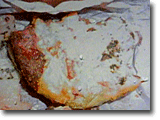
In this photo from KOBTV, marijuana is visible on the right side of the burger.

How stupid does a person have to be to do something like this? Tampering with food is always wrong and should be punished, but you've got to be pretty dumb, to think you're not going to get caught putting marijuana on a cop's burger!

As to suing Burger King for their employees actions, I can certainly see where some people (like the cops) might feel that BK should be held responsible, to some degree, for their employees actions. I'm sure BK wishes they had done drug testing on their employees at this restaurant!
:: full article

  E-voting Failure, Not Fraud

Major electronic voting machine problems occurred in at least six US states during the country's midterm elections, underscoring that system failure, not fraud, is the biggest issue facing future races, voting-rights activists and technologists said this week. Machine problems delayed voting in many precincts in Colorado, Florida, Indiana, and Ohio, requiring election officials to keep the polls open late. Problems in Montana delayed the final tally of the results in that state, and in New Jersey, about five per cent of machines had some sort of problem, though the issues were characterized as minor in news reports.

While the Democratic sweep of the elections may have quelled early partisan concerns regarding fraud, widespread machines failures are not any more acceptable, said Eugene Spafford, a professor of computer science at Purdue University and the chair of the US Public Policy Committee for the Association for Computing Machinery. "From the standpoint of a technologist, we can and should do better," Spafford said. "As a country, we have to do better than machines that can fail and are impossible to audit."

The US midterm elections were the most recent test for electronic voting machines. Many critics warned of the danger of fraud prior to Tuesday's election. The Democrats sweeping win across the nation appears to be the best rebuttal to the worries of some partisan critics. For example, before the election, some Democrats -most notably U.S. Representative Nancy Pelosi (D-Calif.)- seemed prepared to blame a loss on vote fraud.

"That is the only variable in this," Pelosi told the San Francisco Chronicle. "Will we have an honest count?''

However, the danger of a elections being hacked are less of a concern among nonpartisan critics than machine failure, said Courtenay Bhatia, president of election watchdog VerifiedVoting.org.

"The real issue is not fraud," Bhatia said. "The real issue is transparency and whether we have enough transparency to know that our elections are accurate. If problems occur, they are likely to be from errors due to failure or administering the system incorrectly."

While obvious fraud did not occur, software bugs, hardware failure, and poll workers' errors were not in short supply - such problems peppered the electoral landscape on Tuesday.

One widespread phenomenon, at least anecdotally, was the issue of "vote flipping" or "vote jumping," where a voter would discover that pressing the checkbox beside one candidate's name would somehow select a rival. The problem was also reported during the 2004 presidential election as well, Bhatia said.

"That really needs to be independently investigated," said Bhatia. "That is an example of a problem that we had before that obviously didn't get corrected."

Other failures stymied voters as well. Machines in Florida failed to start up properly, while e-polling laptops in Denver could not keep up with the pace of the polls.

The problems had some election workers willing to go back to a simpler time. In Florida's Broward County, one polling station could not get 10 out of 14 machines to accept votes for the first two hours of the election, according to news reports.

"I have two words for them -- paper ballots!" 10-year veteran election volunteer John Miller, 78, told the Miami Herald. "I come from New England and they're still using paper ballots. They have no problems."

Yet, paper ballots also led to a long wait for the final tally, significant errors in counting and still did not eliminate or significantly reduce the chance of fraud, said Daniel Tokaji, an assistant professor of law at Ohio State University's Moritz College of Law.

"I think it is people's intuition that paper is a panacea, but history tells us otherwise," Tokaji said. "The whole reason that we went away from paper ballots to lever machines was because paper was manipulatable."

Purdue University's Spafford stressed that the election problems this year were minor compared to what could happen. Machine failures in a critical state could create an election crisis if there is no backup method for counting people's votes cast on defective machines, he said, adding that such worries are not the province of any particular party.

"The technologists that I know who are concerned about this, span the political spectrum," Spafford said. "They want something that is good for the country--it is not a political issue."

Tokaji agreed that future problems could significantly hinder elections, but maintained that the paper trail mandated by more than half of U.S. states could be the heart of the issue. In a May primary in Cuyahoga County, Ohio, numerous problems, including a large number of failure in the printing of voter verified paper audit trail (VVPAT) ballots, plagued the election.

"I'm very concerned about how well VVPAT recounts are going to work in a close election," Tokaji said. "In Cuyahoga County, there was a lot of problems in the primary, but the finding that troubles me was that (many of) the VVPAT records were damaged or somehow compromised, and that concerns me in a close election."

In the future, the academics and voting-system critics need to work more closely with election officials, Thomas Wilkey, executive director of the Election Assistance Commission, said in an interview prior to the election. The EAC has just completed its public comment period on the federal certification guidelines for new voting systems.

"I am not going to take away from any of the work these folks have done," Wilkey said. "What we would love to see happen is the scientists the academics get together with the true election officials out there."

Until now, most election officials have been wary of academicians, but after the latest election, maybe that will change.

:: full article

  Sony Playstation 3 - Disassembly


  Protests Target Yahoo!

Campaigners have projected a huge world map showing areas where internet speech is suppressed onto the Yahoo! France building in Paris to highlight the portal's snitching against cyber-dissidents in China.

The action yesterday by media rights organisation Reporters Without Borders fingered Belarus, Burma, China, Cuba, Egypt, Iran, North Korea, Saudi Arabia, Syria, Tunisia, Turkmenistan, Uzbekistan and Vietnam as the 13 worst countries for lack of freedom online. It says these nations are "internet enemies", a list it publishes annually.

Egypt is a new entrant to the list for censoring bloggers. Libya was rtemoved from the list after a Reporters Without Borders delegation to the country found the internet was no longer censored there.

The public were invited to record a personal message for Yahoo! co-founder Jerry Yang calling shame on his firm's actions in China. Earlier this year the firm gave up details on two journalists who had highlighted plans to squash commemoration of the Tiananmen Square massacre. Details of the snitch are here. Reporters Without Borders said more than 200 have laid down some thoughts for Yang.

Yahoo! has also faced a barrage of criticism from Amnesty International over its acting as a state informant. Some months after its involvment was confirmed, Yahoo! issued a statement protesting it had "we had no information about the nature of the investigation". Full story here.

:: full article

:: Saturday, November 11, 2006


  The Success Of Firefox

Firefox Web browser co-creator Blake Ross said terminology is just one of the challenges for the future success of the free, open-sourced software. With the recent release of Firefox 2, the Key Biscayne, Fla., resident and 21-year-old Stanford University student sat down to talk about the future of the only Web browser that comes close to competing with Microsoft's Internet Explorer and how it's shaping the future of the Internet.

"A lot of people don't even know what a browser is," said Ross, who was in town for a University of Miami fundraiser. "They think that it's the first thing they use on the Internet. They say, 'What do you mean browser, is that Google? Is that Yahoo?' It's hard to get people to switch browsers if they don't understand the concept."

Firefox is owned by the nonprofit software company Mozilla. Released Oct. 24, Firefox 2 was quickly welcomed into the homes of millions of users. In the first 24 hours, 2 million people were using the browser, with an average of 30 downloads per second. The first version came out in November 2004, and "it's been growing pretty much on a straight line since then," Ross said.

240 Million Downloads

He added that, overall, there have been about 240 million downloads of Firefox software since it launched, but the company estimates there are actually about 7 million to 8 million people who use the browser regularly. That's roughly 12 to 15 percent of Web users, Ross said, many of those being computer savvy.

"We want to spread the word beyond just the tech elite," Ross said.

The browser was designed to be easily understood by the average online user, but Ross admits the average user might not realize the software exists or even what the term "browser" means. So Mozilla is working to spread the word through a grass-roots push, encouraging users to "tell their dentist, tell their family members, tell people they wouldn't normally tell about this product."

Simple Features

Firefox 2 addresses this problem with session restore, which can temporarily save a set of tabs and open them at a later date. Also, if a computer crashes, the new Firefox can restore tabs, text typed in forms and in-progress downloads before it closes.

These new features of Firefox 2 are small details that can make a big impact, including spell-checking for every text box.

"We set a goal for ourselves early on that each Firefox release would get smaller, not larger," Ross said. "Software tends to get larger and larger as companies add more and more features, especially with the products that cost money."

Mozilla has already created a forum for users to recommend new features for Firefox 3, and programmers know what problems they want to take on for the future. Ross said the company hopes to create an easier way to organize a never-ending list of bookmarks. Also in that future lies a new way of looking at browsing altogether: making a browser interface function the same way as a desktop interface.

Ross' future is focused on a different sort of interface. He's taken a semester off of college to work on a side project to be announced a month from now. He couldn't say what it was, but described it this way:

"If Firefox is a response to Internet Explorer, then what we're doing now is a response to Windows."

:: full article

  *Fact of the week*

Mesothelioma is a form of cancer that is almost always caused by previous exposure to asbestos. In this disease, malignant cells develop in the mesothelium, a protective lining that covers most of the body's internal organs. Its most common site is the pleura (outer lining of the lungs and chest cavity), but it may also occur in the peritoneum (the lining of the abdominal cavity) or the pericardium (a sac that surrounds the heart).

Most people who develop mesothelioma have worked on jobs where they inhaled asbestos particles, or have been exposed to asbestos dust and fibre in other ways, such as by washing the clothes of a family member who worked with asbestos, or by home renovation using asbestos cement products. There is no association between mesothelioma and smoking.
:: full article

  Sony's Walkman Creator Retires


"Nobutoshi Kihara, the engineer behind the Walkman, has left Sony. In the late seventies, one of the co-chairman of Sony, Morita, requested the audio division create a portable tape player capable of playing his operas while he was on transpacific flights to the US. After less than a year, the Walkman was released to the public and revolutionized the music industry."

Times have changed since Nobutoshi Kihara sketched out designs for the revolutionary Walkman on a piece of paper.

Kihara, who has slipped quietly into retirement after nearly six decades at Sony, also played key roles in improving the company's televisions and mini video cameras. "We made good, quality products. Our founders also knew the importance of advertising and promotion. That's how the company grew," said the soft-spoken 80-year-old, dressed in a khaki engineer's uniform.

"We did not think about expanding the company for the sake of expansion. It just grew as we worked on our products," he told AFP before retiring as head of a Sony research center where he spent his last working years.

"Back in my days, we had to draw product designs on papers. I would close my eyes and imagine our products. I would imagine joggers with Walkmans to see how the hinges should move or how the products fit into the lives of the users."

Proud to have been a Sony employee and former student of Ibuka, Kihara said he believes the company's rank-and-file engineers will keep pushing the technological boundaries.

"I am confident that our soul as engineers is being passed on to young people. Being unique and creative -- that's the quality of Sony," he said.

Few would dispute that the original Walkman, which went on sale in 1979, changed the way people around the world listened to music.

Ironically, however, US computer maker Apple trumped Sony in the market for new digital portable music players with its phenomenally successful iPod. Sony has also lagged behind rivals like Panasonic in super-thin televisions.

Sony has gone through a turbulent spell in recent years, including recalls of millions of its laptop computer batteries that have dealt a serious blow to its fragile recovery from a profit slump.

As many as 9.6 million Sony batteries could now be recalled and last week the group slashed its full-year operating profit forecast by 62 percent to 50 billion yen (421 million dollars) -- about one-quarter of last year's levels.

On Thursday it posted a second-quarter loss of 20.8 billion yen.
:: full article

  Does eating fish improve brain function?

It is no wonder that health authorities usually recommend the eating of two or three servings of fish per week for most people. This is because fatty, cold-water fish contain healthy omega-3 fats (DHA and EPA). Rich sources of these marine omega-3 fats are sardines, salmon, mackerel, and fresh tuna.

There is some evidence to show that poor dietary intakes or low blood levels of these omega-3 fats can result in learning difficulties, behavioral problems, and mental illness. This may indicate a strong relationship between eating fish and brain development.

Sixty per cent of the brain is composed of fat - but not just any fat. DHA and EPA are good fats. DHA (docosahexaenoic acid) is important for normal brain and vision development. The increased intelligence and academic performance of breastfed compared with formula-fed infants has been attributed in part to the increased DHA content of human milk.

Cultures whose diet is high in DHA have a lower incidence of degenerative diseases of the central nervous system, such as multiple sclerosis. Some children with ADHD and poor school performance have been shown to have insufficient DHA in their diet.

EPA (eicosapentaenoic acid) is also important in brain and eye development and function. EPA has been used to treat depression, bipolar disorder, Huntington's chorea, chronic fatigue syndrome (myalgic encephalomyelitis), obsessive compulsive disorder, and schizophrenia.

According to Dr Shawn Somerset of the School of Public Health at Griffith University in Australia: "No study has proved that eating more fish will make you smarter."

So it is not true that the more fish you eat, the smarter you become. If this were so, then Eskimos, who eat perhaps the highest amounts of fish as any people anywhere in the world, would all be geniuses. Yet having survived for so many centuries in such a brutally harsh environment, perhaps they are.


:: full article

  YouTube faces UTube lawsuit

Universal Tube, a company that sells pipe making machinery, has embarked on a lawsuit against YouTube, claiming that the video sharing site has disrupted its business thanks to the similarity in the two company's web addresses.

Universal Tube's website resides at www.utube.com, and it seems that plenty of wannabe YouTubers, fluent in text-speak, but less adept at typing out full words, are surfing their way over to the Universal Tube site by accident.

In the suit, Universal Tube alleges that its traffic has soared from around 1,500 hits in a month to over two million because of vast numbers of visitors looking for "lewd and other disgusting video".

This, the firm alleges, has caused confusion, cost it money, and caused lost sales.

Universal Tube owner Ralph Girkins issued a statement saying: "This is an enormous expense and distraction for us. Contact with our customers has been disrupted, so I fear we have lost sales. We have even been contacted by police in Australia accusing us of having child pornography on our website. I resent this personally and this confusion is hurting our business."

He notes that his company's site predates YouTube's by a decade or so, and says he is asking either for YouTube to find a new home for its site, or for the company to cough up cash to help his company establish a new corporate identity.

Universal Tube is seeking an unspecified amount in damages, but a lawyer acting for the firm told the press that the suit could be described as "multi-million dollar".

:: full article

:: Friday, November 10, 2006


  Goodbye Rumsfeld!


Yes people, this was our former "Defense Secretary".. Bush is next.
:: full article

  Myspace Adware

Several MySpace pages offer what appear to be YouTube videos that trigger the installation of adware when played, a security company has warned.

The sexually explicit videos can be found on a number of user pages on the MySpace social-networking Web site, Websense said in an alert Monday. They look like YouTube videos, but are in fact hosted on a copycat "Yootube.info" Web site, Websense said. That Web site was still online as of Tuesday evening.

"When users click on the video, they are directed to a copy of the video," Websense said. People are then redirected to the Windows Media Player, which will pop up a license agreement with installation of an adware program called Zango Cash, it said.

"Assuming that users have accepted the agreement, the video downloads and attempts to install setup.exe from Zango Cash," Websense said.

Word of the sneaky installations of Zango's software comes just days after the advertising software maker and the Federal Trade Commission announced a $3 million settlement in response to charges that Zango had breached federal law by deceptively installing its software on consumers' PCs without a clear means of removal.

Zango was formed in June through the merger of 180solutions and Hotbar.

In exchange for displaying ads, Zango gives access to content such as videos, games and tools. The company pays up to 45 cents per installation of the software, according to its Web site. Antispyware programs typically flag the Zango software as "risky."

:: full article